Experimental Analysis of Public Policies
A Master course on applied policy evaluation, causal inference, and econometric design. The course helps students move from a policy question to a credible empirical comparison by making the counterfactual, identifying variation, identifying assumption, and estimand explicit.
Instructor: Etienne Dagorn, Assistant Professor in Economics at LEM-U Lille.
Email: etienne.dagorn@univ-lille.fr
Website: etiennedagorn.github.io/edagorn
Course Map
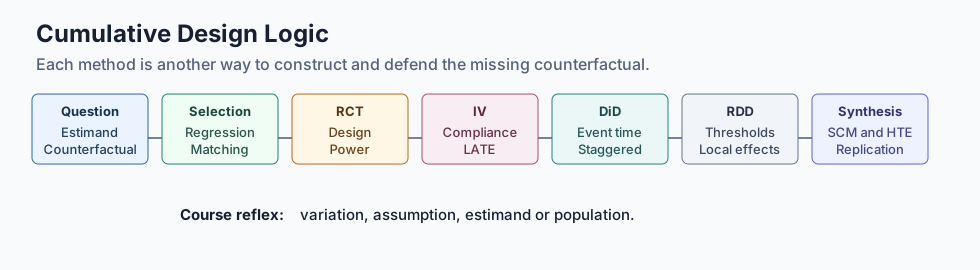
Learning Objectives
Design and Identification
- Formulate a causal policy-evaluation question.
- Define treatment, outcome, population, time horizon, and estimand.
- Explain the missing counterfactual and the selection problem.
- Distinguish description, prediction, estimation, inference, and causal identification.
Methods and Interpretation
- Assess randomised evaluations, IV, DiD, event studies, RDD, and synthetic control.
- Interpret ATE, ATT, LATE, group-time ATT, and cutoff-local effects.
- Use diagnostics without treating them as proof of identification.
- Communicate empirical results to technical and non-technical audiences.
Core Recommended Texts
- Angrist, Joshua D., and Jörn-Steffen Pischke. 2009. Mostly Harmless Econometrics: An Empiricist's Companion. Princeton: Princeton University Press.
- Cunningham, Scott. 2021. Causal Inference: The Mixtape. New Haven: Yale University Press.
Assessment
| Component | Weight | Format |
|---|
| In-class QCM quizzes (x3) | 40% | Short quizzes. |
| Final written exam | 60% | In-class written exam based on applied empirical-design scenarios. |